


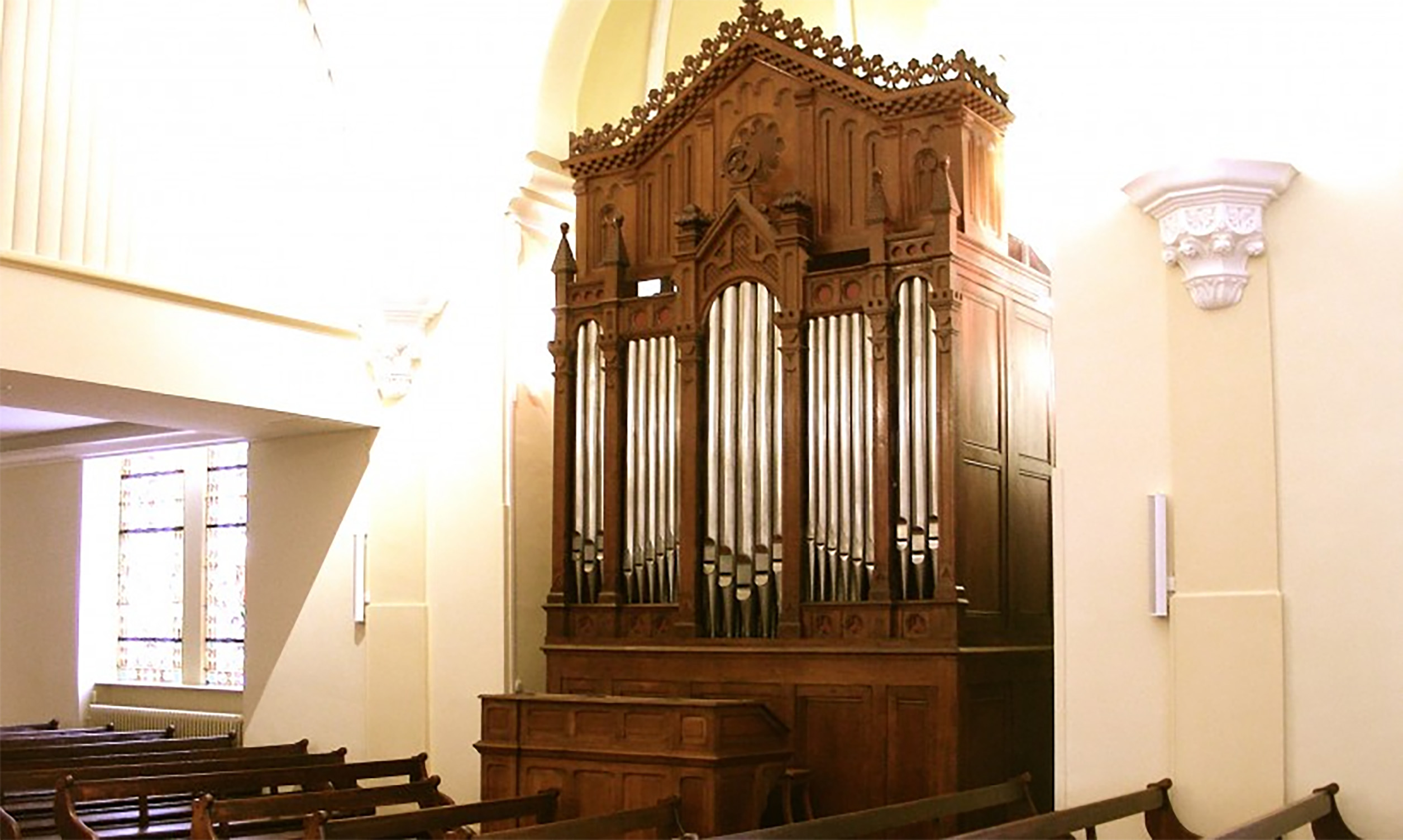
College Ste. Marie
Belfort (F)
French romantic-symphonic organ in the style of the choir organs of the late 19th century.
Built in 1895 by Henry Didier of Épinal and installed in the chapel of this large catholic school. Former employees of Cavaillé-Coll had been employed by Didier at the time and introduced the technical and tonal style of the prestigious Paris company.
Its solid an compact construction, the powerful and efficient sound, containing almost entirely 8’ and 16’-stops and strong reeds, speak of the tonal ideal of the period. It is a perfect example of the type of instruments, built after several models and in great number, mainly placed in bigger churches und cathedrals throughout France.
The age, the condition, an unfortunate reconstruction in the 1960s and water damage made the restauration necessary. Over the course of the restauration we were able to gain a lot of knowledge about the style and restoration-techniques.Restauration and Refurbishment, 2006
Henry Didier, 1895
II / P, 10 Stop, 2 Transmissions
-
Site

40 Fbg des Ancêtres, 90000 Belfort, Frankreich
Google Maps
-
Details
-
Type
Church organ
-
Style
French-Romantic
-
Usage
Worship, Teaching, Concert
-
Collaboration
Marc Garnier, Organbuilder
-
Organiste
Florence Tamarri
-
Adviser
Jean-Charles Ablitzer
-
-
Stop-list
-
Manual I (Grande Orgue)
Compass: C - g'''
Montre 8′
Bourdon 16′
Salicional 8′
Flûte harmonique 8′
Bourdon 8′
Prestant 4′
-
Manual II (Récit expressif)
Compass: C - g'''
Cor de Nuit 8′
Gambe 8′
Voix céleste 8′
Flûte traversière 4′
Basson-Hautbois 8′
Trompette 8′
-
Pedal (Pedal)
Compass: C - f'
Soubasse 16′ (Transmission from Bourdon 16' G.O.)
Flûte 8′ (Transmission from Flûte trav. G.O.)
-
Playing aids
Manual couplers II-I
Pedal coupler I-P
Pedal coupler II-P
Appel Anches
Tremulant
Comments
Pitch: 435 Hz
Tuning: 1/11 pythagorian comma
-
-
Images


-
-


